Washington / Bogotá / Mexico City
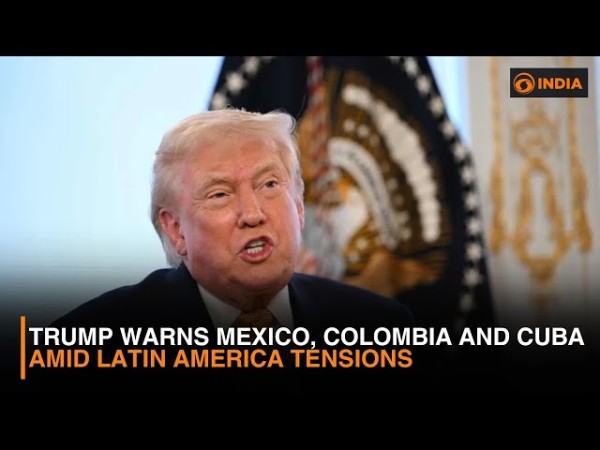
U.S. President Donald Trump has escalated his rhetoric
against neighboring Latin American countries, issuing sharp warnings to Mexico and
Colombia following the dramatic U.S. military
operation in Venezuela that resulted in the capture of President Nicolas
Maduro. Trump’s statements signal a significant shift in U.S. foreign policy
and have sparked concern and strong reactions across the region.
Trump Warns Colombia
In remarks to reporters aboard Air Force One, Trump
accused Colombian
President Gustavo Petro of failing to adequately
address drug trafficking and sharply criticized Bogota’s leadership. He
suggested that a U.S. military operation in Colombia “sounds good to me” if the situation does not improve, a
comment that immediately raised diplomatic and regional alarm.
Trump characterized Colombia’s government as “very
sick,” accusing it of being involved in drug production and implying that U.S.
intervention could be justified. The blunt rhetoric marks a dramatic escalation
from cooperation to confrontation following the Venezuela operation.
Colombian President Petro has strongly rejected the
accusations, calling the U.S. actions an “assault on sovereignty” and warning
that such interference could ignite resistance and destabilize the region.
Message to Mexico
Trump also turned his attention to Mexico,
criticizing the government there for not doing enough to combat drug cartels.
He claimed that powerful criminal networks are effectively “running Mexico,”
and repeated that the United States might consider more forceful action if the
situation does not change.
Though Trump praised Mexican President Claudia Sheinbaum
as “a terrific person,” he emphasized his frustration with what he sees as
insufficient progress against drug trafficking and reiterated his offer to send
U.S. troops to assist Mexico an offer that, so far has not been accepted.
Mexican officials have dismissed the idea of U.S.
military intervention, noting strong bilateral cooperation on security issues
and stressing that addressing cartels requires coordinated law enforcement, not
foreign military action.
Aftermath of Venezuela Operation
Trump’s warnings come in the wake of the controversial
U.S. military operation in Venezuela,
where forces captured President Nicolás Maduro and brought him to the United
States to face drug trafficking charges. That action, which the U.S. government
has described as a law enforcement mission, has heightened tensions across
Latin America and raised questions about Washington’s intentions in the region.
Analysts say Trump’s statements reflect a broader
strategy he calls the “Donroe Doctrine,” an updated version of the historic
Monroe Doctrine that aims to assert U.S. influence in the Western Hemisphere
and counter what he sees as threats to American security and interests.
What’s at Stake?
Trump’s new tone has raised questions about the future
of U.S.–Latin America relations. While Washington insists its goals are
security and stability, critics argue that threats of military intervention may
undermine cooperation and fuel nationalist responses.
For ordinary citizens in Mexico and Colombia, the
developments have stirred anxiety and debate with many hoping for stronger
collaboration on shared challenges like drug trafficking without escalating
tensions.