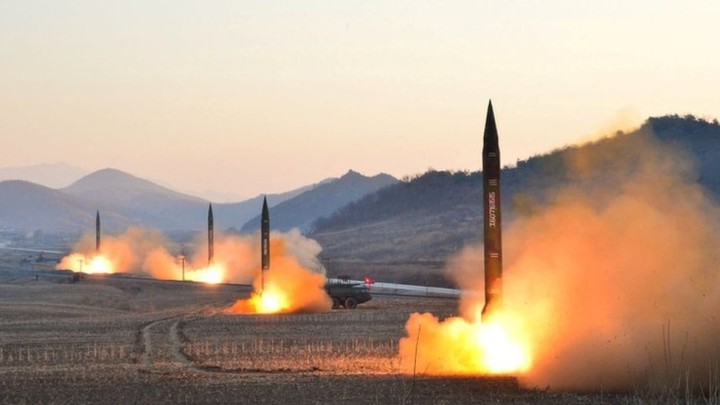
Seoul / Pyongyang
In a dramatic and unsettling development
early today, North Korea launched
multiple ballistic missiles into the East Sea (also known
internationally as the Sea of Japan), marking its first weapons test of the year and raising fresh concerns
about regional security.
According to the South Korean military’s Joint Chiefs of Staff,
the missiles were fired from near Pyongyang
at around 7:50 a.m. local time and flew roughly 900 kilometers before splashing down in the sea.
What
Just Happened?
This morning’s missile launch is
widely interpreted as a deliberate
message of defiance by North Korea. The strike came at a time of heightened geopolitical tension as
South Korea’s president was preparing to visit China for high-level talks and
shortly after a major U.S. military operation overseas.
State media in Pyongyang has also
issued sharp condemnations of recent U.S. actions, labeling America’s strike in Venezuela a “violation of sovereignty”
language that reflects North Korea’s broader narrative of resisting outside
pressure.
Regional
Reactions
The launches were swiftly condemned
by South Korea and Japan, both
of which stressed that the tests violate United Nations Security Council resolutions and pose a threat to
regional peace:
·
South
Korea’s government immediately convened an emergency
national security meeting, calling the missile fire “a provocative act” and
urged Pyongyang to stop such behavior.
·
Japan’s
Defense Ministry confirmed that two missiles reached
altitudes of up to 50 km and flew distances near 900 km, affirming that
Pyongyang’s growing arsenal “threatens regional security.”
·
The United States Indo-Pacific Command said the missiles did not pose
an “immediate threat” to U.S. forces or territory but reiterated that
Washington remains committed to defending its allies and monitoring the
situation closely.
Why does a missile test in the sea matter so much?
·
North Korea’s missile and nuclear
programs are among the most closely watched and controversial in the world,
partly because they defy global
non-proliferation efforts and continue to expand despite sanctions.
·
Launching ballistic missiles even
into the sea is seen as a political
signal, not just a weapons test. It’s a way for Pyongyang to show strength,
resist diplomatic pressure and assert itself on the world stage.
·
Such moves can strain diplomatic
talks, affect military cooperation among neighboring countries, and raise fears
of miscalculation or accidental escalation.
What
Happens Next?
Officials in Seoul, Tokyo, Washington
and Beijing are now closely analyzing
the exact type of missiles used, their range, and flight characteristics
to assess whether this test signals new capabilities or strategic intentions.
Analysts believe this could be an
attempt by leader Kim Jong Un to
demonstrate military readiness and deterrence ahead of significant domestic
political events and global negotiations.
For ordinary people in East Asia,
such news can trigger anxiety and uncertainty reminding the world that, even as
early as the new year, geopolitical tensions remain very real and volatile.