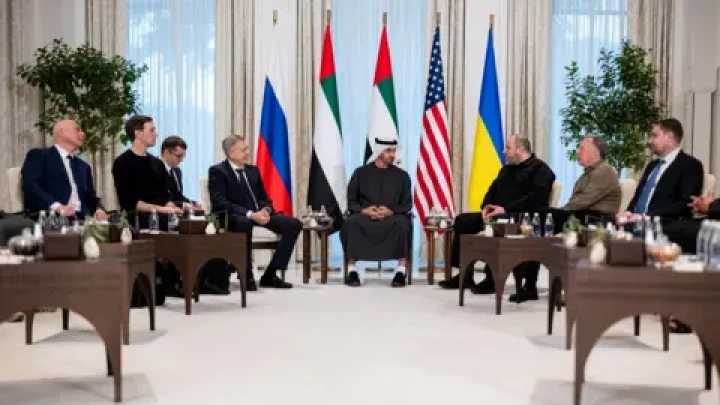
For the first time since Russia’s full-scale invasion of Ukraine in February
2022, official
trilateral peace talks involving Ukraine, the United States
and Russia have begun in Abu Dhabi, marking a significant diplomatic moment in one of the most
devastating conflicts in Europe since World War II.
The discussions, hosted by the United Arab Emirates
at Al Shati
Palace, are expected to run over two days (Friday and Saturday)
and signify a renewed international push to find a negotiated end to the war
that has killed tens of thousands, displaced millions, and reshaped global
geopolitics.
While Ukraine, Russia and the United States
have met separately and through intermediaries in the past, this is the first known trilateral
negotiation since the invasion began in 2022. Representatives
from all three sides are on the ground in Abu Dhabi, with discussions focusing
on the core
political and territorial disputes at the heart of the
conflict.
Ukrainian President Volodymyr Zelenskyy
confirmed ahead of the talks that the meeting is taking place and said his
delegation would discuss how the three sides view ending the war. “The question
of Donbas is key,” Zelenskyy said, referring to the strategically critical
eastern region of Ukraine that remains partly under Russian control.
The status of territory especially
Ukraine’s industrial east is expected to be the most contentious issue.
Russia’s delegation, led in part by senior military and intelligence officials,
has reiterated its demand that Ukraine withdraw from territory it currently
controls in the Donbas region,
a position Kyiv rejects as unacceptable. Ukrainian negotiators argue that
ceding land would undermine their sovereignty and security.
Kremlin spokesman Dmitry Peskov said that Russia considers territorial
concessions essential for any peace agreement, with Russia claiming historical
ties to lands that Ukraine and most of the international community consider sovereign
Ukrainian territory.
The United States is mediating the talks
under the framework developed in recent months, including discussions at the World Economic Forum in
Davos, where Zelenskyy and U.S. President Donald Trump
met to align on peace strategy and security guarantees for Ukraine. U.S.
officials say part of the aim is to secure a ceasefire and outline a formula
for lasting peace, though they stress that progress depends on all sides.
Zelenskyy has previously said that Kyiv has
secured security
guarantees from the U.S. and other Western allies, which would
be critical to any peace agreement especially if hostilities were to end
without full territorial resolution.
After the first day of talks, Ukrainian and
U.S. officials described discussions as productive but preliminary, with no
formal agreements reached and positions unchanged on the central
dispute. Zelenskyy cautioned that it is still “too early to draw conclusions”
and emphasised that Russia must demonstrate genuine readiness to end the war.
A senior U.S. official told reporters that
the negotiations will continue into the second day with a focus on building
consensus around a framework for peace. Meanwhile, Russian officials
highlighted the importance of security arrangements and implementation of
previously discussed formulas as part of next steps.
The UAE’s Deputy Prime Minister and Minister of Foreign
Affairs, Sheikh Abdullah bin Zayed, welcomed the start of the
talks, framing them as a positive step toward diplomatic resolution. He
expressed hope that the summit would deliver “tangible steps” toward peace in
Ukraine, underscoring the UAE’s role as a neutral host willing to facilitate
dialogue.
Despite the diplomatic efforts, the conflict
on the ground remains intense. Russia continues military operations and Ukraine
faces ongoing attacks on infrastructure and civilian areas, including recent
disruptions to power and heating in major cities due to strikes on energy
networks. These realities add urgency to the negotiations but also complicate
them, as each side grapples with battlefield dynamics and political demands.
With negotiations set to resume on Saturday,
international observers and governments are watching closely. The talks do not
guarantee peace but represent a rare public meeting with all three parties at the
table, raising hopes that dialogue remains possible after
nearly four years of conflict. Progress will likely depend on whether the
parties can find mutually acceptable compromises on territorial control,
security guarantees, and postwar reconstruction.