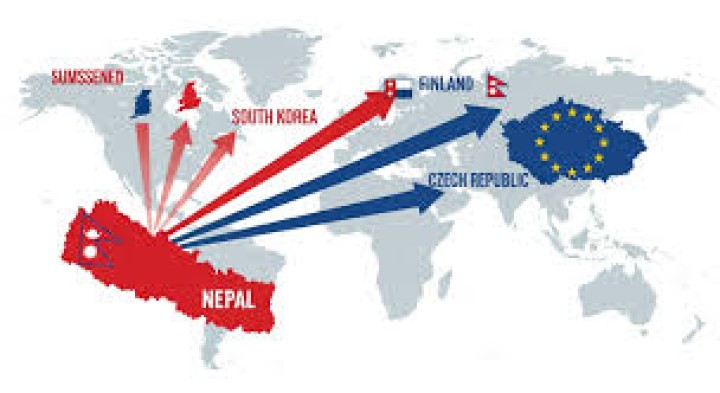
Nepal has the world highest labor migration with millions of Nepalese having their work in other countries to take care of their families. The economy of Nepal depends on remittances of these workers who comprise a large portion of the economy (approximately 25 percent of GDP in recent years).
Recent statistics tell a very simple story: the upper
hand is taken by the Gulf nations (GCC countries), then there are some others.
Europe is emerging rapidly as an alternative because of higher wages and safer
working conditions, as well as worker rights, although Gulf spots still claim
most (usually 70-80 percent of permits)
1.
United Arab Emirates (UAE)
Reasons
why it is the best: Construction, logistics, hospitality,
security, and services are in high demand. Lots of Nepalis get occupations they
enjoy, and good wages (particularly the ladies in domestic or service
positions). Dubai and Abu Dhabi are trendy.
Recent
statistics: UAE registered the highest number of new
labor approvals (e.g., 17,000+ in the first month) at the beginning of 2025/26.
It led the pack during most, and the large gains (more than 100 per cent in
several quarters).
Advantages:
Higher satisfaction levels, increased employment options, and more convenient
to women (many are now taking permits).
Cons:
It is hot, there are long hours but usually safer than in certain Gulf spots.
Common
occupations: Construction worker, driver, house
cleaner, hotel workers.
2.
Qatar
Why
it is popular: Massive infrastructure works (post-World
Cup legacy), construction and services. High demand for workers.
Recent
figures: usually 2 or 3, and good in renewals (e.g. 32 share
in some 2025 figures). The flow is steady, with numerous returns.
Advantages:
Fairly high salaries, formal agreements.
Cons:
High administrations, heat, historical problems with employee rights (but
getting better).
Examples
of jobs: Building, safety, housekeeping, service.
3.
Saudi Arabia
The
reason why it is selected: Huge economy, unlimited construction
and service work. Long history as a top spot.
Recent
statistics: Often amongst the 3-5, with good figures
(e.g., 16 per cent share in recent months, huge increases in certain months).
Pros:
This has numerous opportunities and is also familiar to Nepalis.
Con:
Strenuous work, exploitation in a few instances.
Common
jobs: Worker, chauffeur, househelp.
4.
Kuwait
Why
it is desirable: Economy characterized by oil requires
construction, domestic and services workers.
Recent
statistics: Stable at best 5, frequently 5-10% share.
Pros/Cons:
Just like other gulf- good wages but there are threats such as a problem with
kafala system.
Common
occupations: Building, housekeeping, guarding
5.
Malaysia
Worth
the historical size: Factories, plantations, manufacturing,
and services. Was #1 for years.
Recent
statistics: The position remains in the top 5 but
decreases (significant drops to 68% in certain intervals because of changes in
policy and rivalry).
Advantages:
Greater accessibility in the past, variety of jobs.
Disadvantages:
History of bans, great danger (accidents, deaths), money problems.
Examples
of jobs: Factory worker, plantation labor, security.
Quick Comparison Table (Based on Recent Trends)
|
Rank |
Country |
Approx.
Share (Recent Data) |
Main
Sectors |
Key
Notes (2025/26) |
|
1 |
UAE |
25-40% |
Construction, Hospitality |
#1 in many months, rising fast |
|
2 |
Qatar |
10-30% |
Construction, Services |
Strong in renewals |
|
3 |
Saudi Arabia |
15-20% |
Construction, Labor |
Consistent top choice |
|
4 |
Kuwait |
5-10% |
Domestic, Construction |
Steady |
|
5 |
Malaysia |
Declining (was high) |
Manufacturing, Plantation |
Dropping due to policies |
|
Emerging |
Romania/Poland/Croatia |
Growing (10-15% combined Europe) |
Agriculture, Factories |
Better pay & rights, fast
increase |
Emerging
& Rising Destinations (Europe and others)
1. Romania:
Europe fastest-growing (monumental increases, e.g., 200%+ in one set of data).
Agriculture, construction.
2. Poland,
Croatia, Portugal, Cyprus, Malta: Increasing because of the increased salaries,
secure laws, softer climate.
3. Others
prominent targets include South Korea (EPS system -better pay but quotas
restricted and competitive) and Japan (skilled work) Oman/Bahrain (Gulf but
smaller).
Important
Notes:
· The
total new approvals will be more than 300,000-500,000 annually.
· There
are a lot more of them who are going there on a border or seasonal work (no
visa required) and they are not followed in the same manner.
· There
is a threat of exploitation, unfavourable conditions, deaths (thousands of them
over a period of time), and safe migration (licensed agencies) is essential.
· Trends
change: gulf king of easy access, but Europe on the rise of quality of life.
To get the latest precise figures, refer to DoFE web
site (dofe.gov.np) or recent publications, the figures are updated each month!
Research visas, agencies and rights are something to think about when you are
thinking of going.